Are you and your partner truly on the same wavelength when it comes to communication? Or do you sometimes find yourselves influenced by TikTok or Instagram reels, treating them as the “rulebook” for your relationship?
While these 30-second videos may go viral, they rarely capture the depth and complexity of real relationships. Because in reality, communication challenges don’t usually show up as dramatic moments; they build quietly over time.
You may find yourselves repeating the same arguments. Or maybe things feel quieter, but not in a peaceful way, more like a sense of distance or disconnection. Sometimes, it’s not even about what is being said, but how it’s being received.
What many couples experience is not a lack of communication, but patterns that no longer feel safe, clear, or supportive. And unlike what social media often suggests, these patterns aren’t solved by quick fixes or generic advice.
Every relationship is different, and meaningful change often requires deeper understanding and guidance through couples therapy.
This is where couples therapy begins to shift things. Not by teaching you how to “talk better” overnight, but by helping you understand what’s happening underneath the conversation, the emotions, expectations, and reactions shaping how you relate to each other.
In this blog, we’ll explore how couples therapy for communication issues works, what research tells us about the benefits of couples therapy, and how it can help rebuild connection in a way that feels steady and sustainable.
What Does Communication Mean in Relationships?
Communication is often thought of as words. But in relationships, it goes far beyond that.
It includes:
- Emotional safety
- Tone and body language
- Timing and readiness
- Past experiences influencing present reactions
Two people can say the same thing, but experience it completely differently.
Research in relationship counseling for couples highlights that communication challenges are often rooted in emotional disconnection, stress, and unresolved patterns, not simply poor speaking skills.
This is why couples therapy does not just focus on communication techniques. It focuses on how partners experience each other emotionally.
4 Common Reasons Why Communication Breaks Down
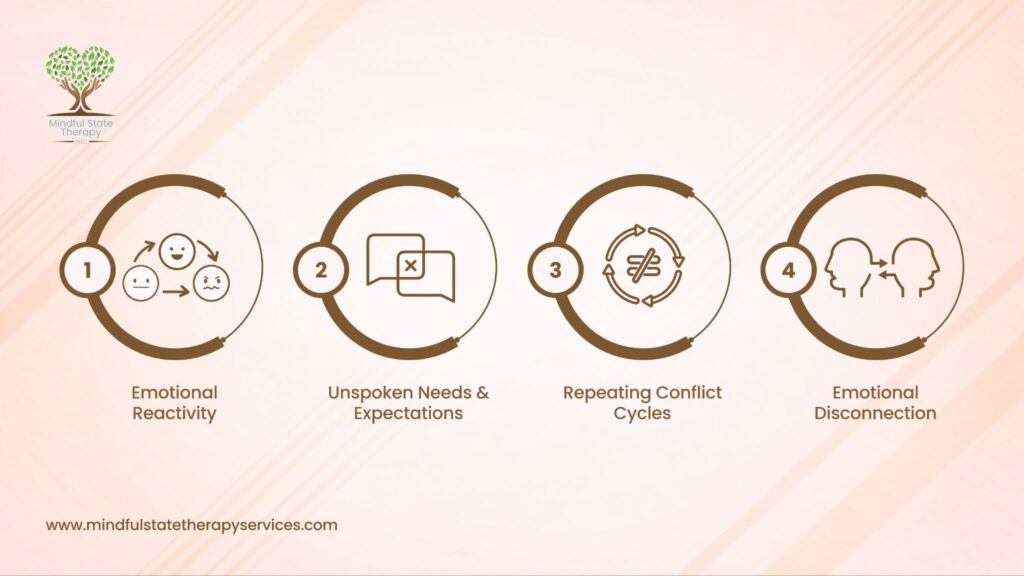
Even in strong relationships, communication can become strained over time. This is where therapy for relationship problems often begins, by identifying patterns beneath the surface.
Research and clinical work in couples therapy consistently point to a few underlying dynamics that shape these breakdowns.
- Emotional Reactivity
When the nervous system feels overwhelmed, communication shifts from thoughtful to automatic.
Instead of pausing and responding, partners may move quickly into:
- Defensiveness
- Criticism
- Withdrawal
These reactions are protective, not intentional. Over time, this is where couples therapy helps slow down responses and rebuild safer communication patterns.
For example, what begins as a simple concern can quickly escalate:
- One partner feels unheard → raises their voice
- The other feels attacked → shuts down or becomes defensive
At this point, the conversation is no longer about the original issue. It becomes about managing emotional discomfort. Over time, these reactive patterns can make even small conversations feel exhausting or unsafe.
- Unspoken Needs & Expectations
Many conflicts are not really about what is being discussed on the surface.
They are about deeper, often unspoken needs, such as:
- Wanting to feel appreciated
- Wanting to feel seen or understood
- Wanting reassurance, support, or emotional closeness
The challenge is that these needs are not always clearly expressed. Instead, they may show up as:
- Frustration
- Irritation
- Disappointment
For example:
“I wish you had helped more.” may actually mean “I want to feel supported and not alone in this.”
Without clarity, frustration replaces communication. This is a common focus area in couples therapy for communication issues, where partners learn to express needs more clearly.
- Repeating Conflict Cycles
One of the most well-researched patterns in cognitive-behavioral couple therapy is how thoughts, emotions, and behaviors reinforce one another.
Over time, couples can get caught in predictable loops:
- A thought arises: “They don’t care about me.”
- This leads to feelings like hurt or frustration
- Which then leads to behaviors like criticism or withdrawal
The other partner responds, and the cycle continues.
For example: “If they cared, they would know” → frustration → criticism → defensiveness → more disconnection
These cycles are a fundamental focus in both marriage counseling services and couples therapy, where partners learn to interrupt patterns and respond differently.
- Emotional Disconnection
At the core of many communication struggles is a sense of emotional distance. Emotion-focused research shows that relationship distress is often linked to unmet attachment needs, such as:
- Feeling valued
- Feeling safe and secure
- Feeling emotionally close and connected
When these needs are not met, partners may:
- Withdraw to protect themselves
- Become critical in an attempt to be heard
- Feel lonely even within the relationship
What may look like anger or avoidance is often a deeper expression of:
“I don’t feel close to you right now.”
These patterns do not mean something is broken in the relationship. They reflect natural human responses to stress, unmet needs, and emotional overwhelm.
And most importantly, they are patterns that can be understood, shifted, and healed with the right support.
| The Science Behind Couples Therapy Studies show that up to 70% of couples report improvement after couples therapy. Moreover, multiple studies indicate strong effectiveness, with large effect sizes in reducing relationships. Also, around 60–72% of couples experience meaningful improvements in satisfaction Two of the most researched approaches include: Cognitive Behavioral Couple Therapy (CBCT)Emotion-Focused Couple Therapy (EFCT) Interestingly, research shows that both approaches are equally effective, even though they work differently.CBCT focuses on thoughts, behaviors, and communication skillsEFCT focuses on emotional bonding and attachmentBoth approaches demonstrate the benefits of couples therapy, helping couples: Understand each other betterReduce distressImprove communication and connection |
How Couples Therapy Strengthens Relationships
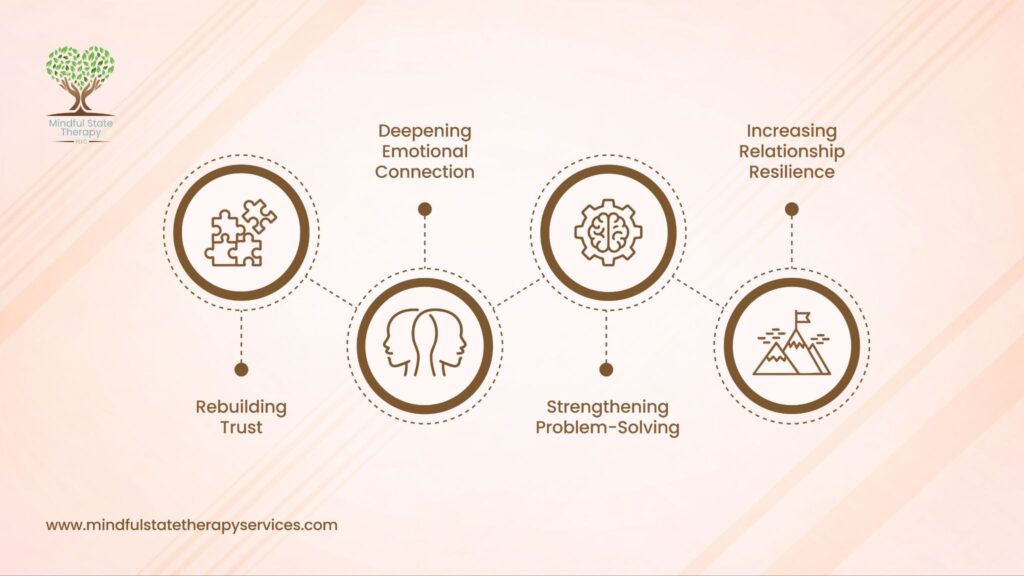
Improved communication is often the first shift couples notice, but the impact of couples therapy goes far beyond just talking differently. Over time, it reshapes how partners relate to each other emotionally, how they respond during stress, and how they grow together through challenges.
Rebuilding Trust
Trust is not rebuilt through promises or quick fixes. It develops gradually through consistent, safe, and reliable interactions. In couples therapy, partners begin to experience new patterns of responding to each other.
Conversations feel less reactive and more intentional, creating space for emotional safety to return. This process often includes:
- Responding instead of reacting
- Following through on small commitments
- Creating moments of emotional reliability
Over time, these small shifts help restore a sense of stability and trust within the relationship.
Deepening Emotional Connection
Many couples find that over time, communication becomes focused on daily tasks rather than emotional connection. Couples therapy helps partners move beyond surface-level conversations and understand what lies underneath them.
Instead of just hearing words, partners begin to understand emotions, needs, and intentions more clearly.
This shift supports:
- Feeling seen and understood
- Expressing emotions more openly
- Building a stronger sense of closeness
As emotional understanding deepens, the relationship feels more secure and connected.
Strengthening Problem-Solving
In many relationships, conflict turns into a cycle of trying to win, defend, or prove a point. Through couples therapy, partners learn how to approach challenges differently. The focus shifts from opposition to collaboration.
This includes developing:
- Collaborative thinking instead of blame
- Shared decision-making
- Respectful disagreement without escalation
Over time, problems become something couples work through together, rather than something that creates distance between them.
Increasing Relationship Resilience
Every relationship goes through periods of change. Transitions such as parenthood, career shifts, loss, or relocation can place significant strain on connection and communication.
Research shows that couples therapy helps partners guide these changes more effectively by strengthening emotional awareness and adaptability.
Couples build the ability to:
- Stay connected during stress
- Communicate clearly during uncertainty
- Support each other through life transitions
This resilience allows the relationship to remain steady, even as circumstances evolve.
Ultimately, couples therapy is not just about resolving current challenges. It is about building a relationship that can adapt, reconnect, and continue growing over time.
Benefits of Couples Therapy
Many people assume that relationship counseling for couples or the benefits of couples therapy are only relevant when a relationship is already struggling. However, that’s far from the full picture.
In reality, many couples choose couples therapy not because something is “wrong,” but because they want to better understand each other, strengthen their bond, and grow together. Whether you’re exploring therapy for relationship problems or simply looking to improve connection, seeking couples therapy for communication issues doesn’t have to come from a place of crisis.
In fact, early and proactive support often leads to deeper, more sustainable relationship growth.
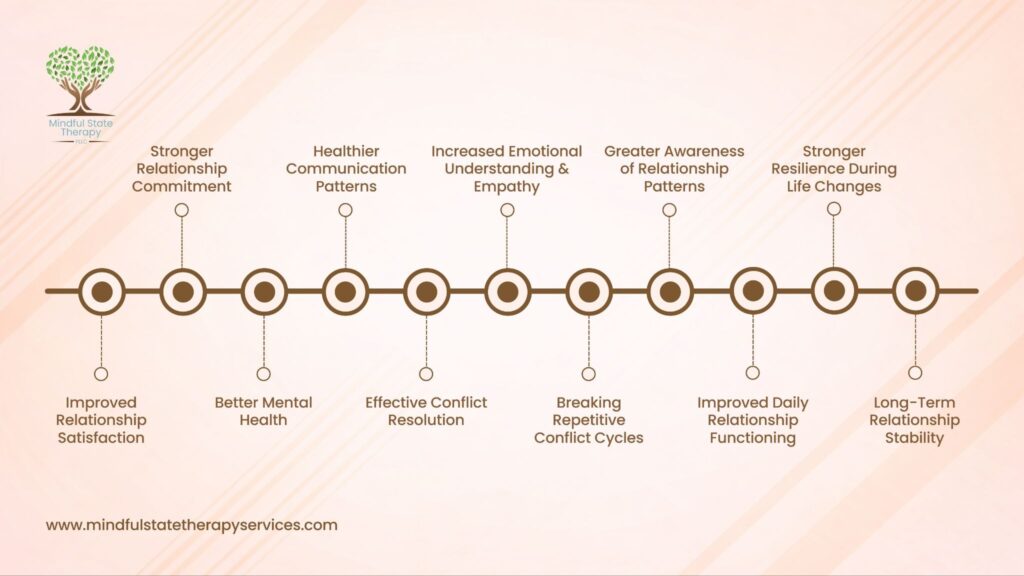
Here are some of the pivotal benefits of couples therapy:
- Improved Relationship Satisfaction: Research shows that couples therapy can significantly enhance partners’ satisfaction with their relationship. Many couples report feeling more connected, understood, and supported, both during the process and long after.
- Stronger Relationship Commitment: Through couples counseling, partners often reconnect with the reasons they chose each other in the first place. As emotional safety and communication improve, commitment naturally deepens.
- Better Mental Health: Relationship stress is closely linked to anxiety and depression. Working with a licensed couples therapist can help reduce emotional strain, improving both individual well-being and relationship health.
- Healthier Communication Patterns: One of the most important benefits of couples therapy is learning how to communicate effectively. Couples develop the ability to express themselves clearly and listen with intention, reducing misunderstandings and emotional escalation.
- Effective Conflict Resolution: Instead of repeating the same arguments, couples therapy for communication issues helps partners navigate disagreements with clarity, respect, and collaboration.
- Increased Emotional Understanding & Empathy: With guidance from a licensed couples therapist, partners gain deeper insight into each other’s emotions, needs, and triggers, creating stronger empathy and connection.
- Breaking Repetitive Conflict Cycles: A core focus of therapy for relationship problems is identifying patterns that lead to recurring conflicts. Couples learn how to respond differently rather than reacting automatically.
- Greater Awareness of Relationship Patterns: Couples therapy helps uncover how past experiences, assumptions, and emotional responses influence present interactions, bringing clarity to long-standing dynamics.
- Improved Daily Relationship Functioning: Over time, small everyday interactions become more positive, predictable, and supportive, strengthening the overall relationship experience.
- Stronger Resilience During Life Changes: Whether it’s career shifts, parenting, or unexpected challenges, marriage counseling services help couples stay connected and supportive during periods of stress and transition.
- Long-Term Relationship Stability: The skills learned through couples therapy continue to support the relationship well beyond the sessions, helping maintain growth, trust, and connection over time.
Ultimately, one of the most effective benefits of couples therapy is the shift from reactive patterns to intentional, thoughtful responses, creating a more grounded and emotionally secure relationship.
When to Consider Couples Therapy
You don’t have to wait until things feel overwhelming. Couples therapy is often most effective when started early, creating space to understand what’s happening beneath the surface before disconnection deepens.
You might consider couples therapy if:
- Communication feels stuck or strained
- The same arguments repeat without resolution
- There is a growing emotional distance
- Trust has been affected
- Life changes are creating pressure on the relationship
Many couples wait years before reaching out, even though earlier support often leads to more meaningful and lasting improvements.
What to Expect from Couples Therapy
Understanding the process can make therapy feel more approachable. Sessions are typically held weekly, last around 45 to 60 minutes, and are structured yet flexible to allow for open, guided conversation.
A typical process may include:
- Joint conversations where both partners share their experiences
- Guided exercises to support communication and emotional awareness
- Exploration of relationship history and recurring patterns
- Practical tools to apply between sessions
Rather than focusing only on surface-level issues, couples therapy helps uncover the patterns that shape how partners relate to each other, including emotional responses, communication habits, and past experiences.
The therapist acts as a neutral, supportive guide rather than someone who takes sides. The goal is to help both partners feel heard, understood, and respected, so conversations can move from conflict toward clarity.
Progress looks different for every couple. Some notice shifts within a few sessions, while others benefit from a longer process to create lasting change.
What makes the biggest difference:
- Willingness to engage honestly
- Openness to listening and reflecting
- Consistency in applying what is learned
Early support through marriage counseling services often leads to better outcomes.
Strengthen Your Relationship with a Licensed Couples Therapist at Mindful State Therapy
Relationships can feel deeply fulfilling, but also complex and, at times, overwhelming. When communication becomes strained or the connection feels distant, it does not mean something is broken. It often means support is needed.
At Mindful State Therapy Services PLLC, our couples therapy approach is trauma-informed, relationship-centered, and grounded in both emotional and evidence-based care. We integrate approaches such as cognitive behavioral couple therapy and emotion-focused work to support communication, emotional safety, and lasting connection.
Our work focuses on helping you:
- Understand patterns without blame
- Communicate with clarity and intention
- Rebuild trust and emotional closeness
- Strengthen your relationship in a way that feels sustainable
We believe healing happens in a space that feels safe, collaborative, and respectful of both partners.
Schedule your 20-minute consultation.