
You remember being a child, when you did not need a screen or a shelf full of toys to stay entertained. You could turn a cardboard box into a spaceship, a stick into a magic wand, or the floor into lava. Before iPads and constant notifications, imagination did most of the heavy lifting. We were curious, inventive, and completely absorbed in whatever story we created.
That natural creativity was not accidental. It was playing what it does best.
Play is at the heart of childhood. It is how children explore, imagine, experiment, and connect. Through play, they test boundaries, rehearse real-life situations, process experiences, and build social and cognitive skills. It is joyful, spontaneous, and essential for healthy development.
But while all therapeutic play includes play, not all play is therapeutic.
This is where confusion often begins. Many parents and even early-career professionals wonder about the difference between play and therapeutic play. Is play therapy simply playing with toys? Is it just structured fun? Or is there something deeper happening beneath the surface?
Understanding the distinction between therapeutic play and regular play becomes especially important when a child is struggling emotionally, behaviorally, or developmentally. When play redirects from simple imagination to a means for healing, the intention and the role of the adult change significantly.
In this blog, we will explore the difference between play and therapeutic play, how play therapy differs from normal play, and why structured therapeutic work requires specialized training.
What Is Regular Play?
Play is a natural developmental process. It is self-directed, creative, and often spontaneous. Children use play to:
- Explore their environment
- Develop motor and cognitive skills
- Practice social roles
- Express imagination
- Reduce everyday stress
Researchers consistently describe play as a primary language of children. Unlike adults, who rely heavily on words, children communicate through action, symbolism, and imagination. Through unstructured play, they rehearse life.
Examples of regular play include:
- Building with blocks
- Pretend kitchen scenarios
- Playing tag
- Drawing freely
- Engaging in imaginative storytelling
This is often called unstructured play. In the conversation about structured vs. unstructured play, unstructured play is child-led and free of adult goals. It is essential for creativity, independence, and natural emotional expression.
However, regular play does not automatically involve assessment, clinical interpretation, or therapeutic intervention.
What Is Therapeutic Play?
Therapeutic play is not simply playing with a child. It is the systematic, theory-informed use of play within a clinical framework to help children prevent or resolve psychosocial difficulties.
Play therapy is a structured interpersonal process in which trained therapists use the therapeutic power of play to support optimal growth, emotional healing, and developmental repair. Its foundations trace back to early theorists such as Piaget, Anna Freud, Melanie Klein, Winnicott, and Virginia Axline, who recognized that play is the child’s primary mode of symbolic expression.
This is where the difference between play and therapeutic play becomes clear.
In therapeutic play vs regular play:
- The play has intentional therapeutic goals
- The therapist observes symbolic and relational themes
- Emotional and nervous system patterns are tracked
- Interventions are developmentally and trauma-informed
- Safety, pacing, and ethical boundaries are structured
- The therapeutic relationship is central
The toys become the child’s language. The therapist becomes a trained listener, regulator, and interpreter of meaning.
Play Therapy vs Normal Play: Comparing the Basics
Understanding play therapy vs normal play requires examining intention, structure, theoretical grounding, and clinical expertise.
1. Intention
Normal play supports enjoyment, creativity, and natural developmental growth. Therapeutic play is designed to support healing, emotional regulation, trauma integration, and relational repair. It is preventive and restorative, particularly when development has been disrupted.
2. Structure
In discussions of structured vs unstructured play: Regular play is typically spontaneous and unstructured.
Therapeutic play, even when non-directive, operates within clearly maintained therapeutic boundaries. Time is consistent. The space is intentionally prepared. Emotional safety is protected.
Even child-centered play therapy, inspired by Axline’s principles, maintains structure through:
- Secure boundaries
- Emotional reflection
- Developmentally attuned pacing
- Stable therapeutic presence
Structure does not control the child. It protects the process.
3. Observation and Interpretation
During regular play, adults supervise for safety. During therapeutic play, a clinician observes:
- Symbolic themes
- Repetitive narratives
- Emotional shifts
- Trauma responses
- Attachment patterns
- Regulation capacity
This highlights a central difference between play and therapeutic play: the former is grounded in trained interpretation, informed by developmental psychology, attachment theory, and the science of play; the latter is grounded in untrained interpretation.
| Clinical Snapshot: When School Pressure Shows Up in the BodyAge 9 | Academic StressA child began experiencing seizure-like episodes only at school. Medical causes were ruled out. In play therapy, she used dolls to recreate classroom scenes and family interactions.Through symbolic play, pressure to “perform perfectly” surfaced. As emotional stress reduced and expectations shifted, the episodes stopped.Sometimes a child’s body speaks what words cannot.Source |
Play becomes both a diagnostic window and a healing vehicle.
4. Goals
Regular play supports general development and imagination.
Therapeutic play has defined clinical goals, including:
- Emotional regulation
- Trauma processing
- Social skill development
- Reduction of behavioral difficulties
- Strengthening attachment security
- Supporting major life transitions
These goals are shaped by assessment, ethical care, and collaborative family involvement.
Types of Therapeutic Play
There are several types of therapeutic play, each grounded in theory and clinical application.
1. Child-Centered Play Therapy
Influenced by Carl Rogers and Virginia Axline, this model emphasizes:
- Acceptance of the child
- Emotional reflection
- Non-directive but structured containment
- Trust in the child’s capacity for growth
- Secure relational boundaries
The therapist serves as a steady emotional anchor.
2. Cognitive Behavioral Play Therapy
This approach integrates cognitive-behavioral principles with developmentally appropriate tools. It helps children:
- Identify thought-feeling-behavior links
- Develop adaptive coping strategies
- Practice emotional regulation through play-based exercises
3. Adlerian Play Therapy
Focused on belonging and social interest, this model explores lifestyle patterns and encourages healthier relational behaviors.
4. Group Play Therapy
Used in schools and clinical settings to improve peer interaction, reduce disruptive behaviors, and strengthen social-emotional skills under professional guidance.
These various types of therapeutic play demonstrate that therapeutic intervention is grounded in theory rather than improvisation.
Benefits of Therapeutic Play
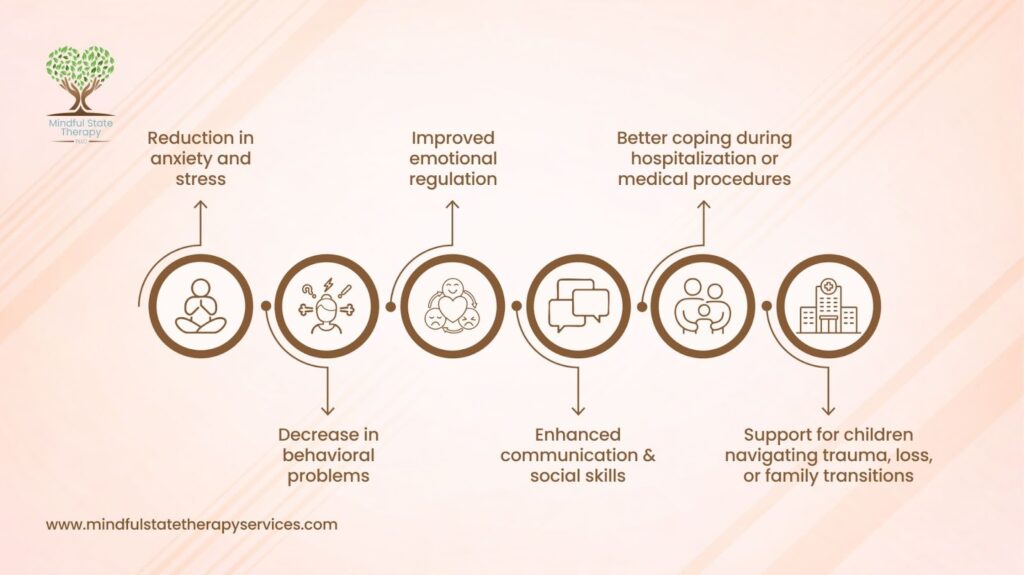
Research consistently supports the benefits of therapeutic play across educational, clinical, and medical settings. Documented benefits include:
- Reduction in anxiety and stress
- Decrease in behavioral problems
- Improved emotional regulation
- Enhanced communication & social skills
- Better coping during hospitalization or medical procedures
- Support for children navigating trauma, loss, or family transitions
Studies show improvements in children experiencing:
- Speech difficulties
- ADHD
- Chronic illness
- Hospital-related stress
- Divorce-related adjustment challenges
These findings reinforce that therapeutic play vs regular play yields different outcomes when clinical intervention is required.
| Clinical Snapshot: Grief Behind School RefusalAge 5 | Loss & Separation AnxietyAfter her grandfather passed away, the child refused to go to school and struggled with sleep. Through drawing and gentle non-directive play, grief themes slowly emerged.As emotions were processed safely, she returned to school and began sleeping peacefully again.Healing often begins when a child feels safe enough to remember.Source |
The benefits of therapeutic play are especially significant for younger children who cannot yet verbalize complex emotions due to developmental limitations.
Structured vs Unstructured Play in Therapy
Therapeutic sessions may appear child-led, but they are never uncontained.
Structured vs unstructured play in therapy includes:
- The child chooses materials
- The therapist tracks symbolic and emotional themes
- Clear therapeutic boundaries are maintained
- Psychological safety is actively supported
- Time and pacing are consistent
- The therapist uses themselves as a regulated instrument of change
The structure is subtle but intentional.
Without theoretical grounding, ethical awareness, and diagnostic understanding, attempts to replicate therapeutic play may miss trauma cues or unintentionally overwhelm the child.
When Does a Child Need Therapeutic Play?
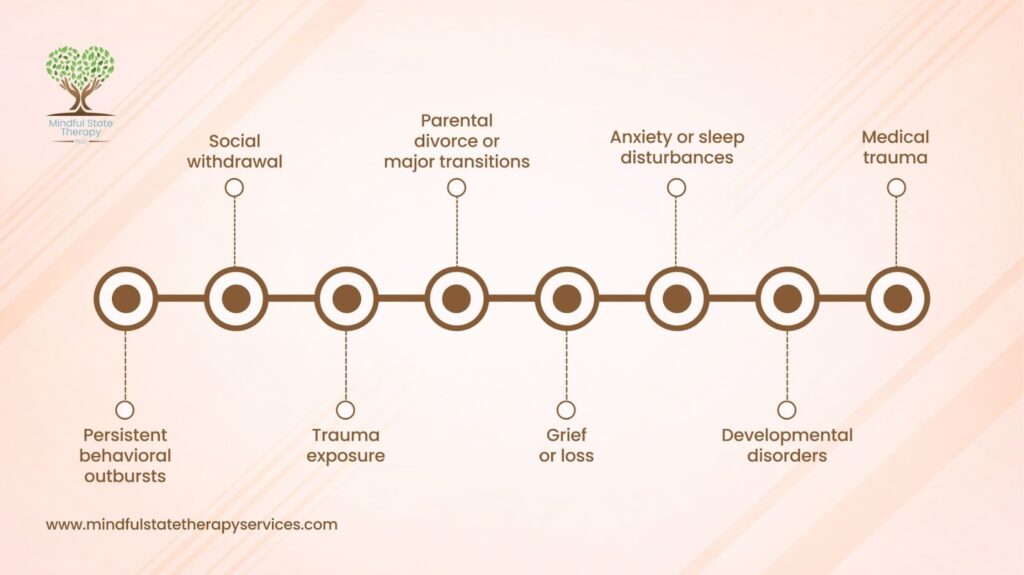
Regular play supports healthy development. However, therapeutic play may be indicated when a child experiences:
- Persistent behavioral outbursts
- Social withdrawal
- Trauma exposure
- Parental divorce or major transitions
- Grief or loss
- Anxiety or sleep disturbances
- Developmental disorders
- Medical trauma
In these situations, the difference between play and therapeutic play becomes clinically significant. Therapeutic intervention ensures emotional expression is safely supported, accurately interpreted, and meaningfully integrated.
| Clinical Snapshot: A Quiet Child Pulling His HairAge 6 | Family Conflict & WithdrawalAfter the birth of a sibling, the child became withdrawn and began pulling his hair. In the playroom, he used miniature figures to express tension and conflict at home.With therapeutic support and parental guidance, the behavior gradually stopped.Play allowed him to show what he could not yet say.Source |
Significance of Therapeutic Play with a Trained Specialist
Research consistently emphasizes one critical factor in effective therapeutic play: proper theoretical training combined with accurate clinical assessment.
The impact of therapeutic play depends on a specialist’s ability to:
- Understand developmental stages and age-appropriate expression
- Recognize trauma responses and attachment patterns
- Maintain clear ethical and therapeutic boundaries
- Collaborate meaningfully with families and caregivers
- Apply evidence-based, theory-driven interventions
- Remain culturally and contextually responsive
The difference between play therapy vs conventional play is not about access to more toys or activities. It is about clinical skill, relational attunement, structured containment, and thoughtful integration of theory into practice.
Without specialized training, play remains supportive and enriching.
With a trained specialist, play becomes a guided pathway toward emotional healing and long-term growth.
Support Your Child’s Emotional Growth with Mindful State Therapy

When a child is struggling emotionally or behaviorally, it can be difficult to know whether everyday play is enough or if deeper support is needed. Understanding the difference between play and therapeutic play is often the first step. The next step is ensuring your child has access to care that is developmentally informed, emotionally attuned, and clinically grounded.
At Mindful State Therapy Services PLLC, we offer specialized play therapy designed to meet children where they are. Our trained clinicians create a safe, structured environment where children can express themselves through their natural language of play while receiving thoughtful therapeutic guidance. Each session is rooted in attachment awareness, trauma-informed practice, and respect for your child’s pace.
Whether your child is navigating anxiety, behavioral challenges, life transitions, or emotional overwhelm, therapeutic play can provide a pathway toward regulation, resilience, and a stronger connection.Schedule your 20-minute consultation to learn how we can support your child’s growth through intentional, compassionate play therapy.